Peptide Pureness & Quantitation Screening
@mariospjq241
October 12, 2026 · 4 min read
Peptide Pureness & Quantitation Screening
Finally, comprehending peptide purity levels and grades aids you make educated choices for your experiments. A peptide's purity percentage informs you just how much of that sample is the genuine deal versus spin-offs, with common research grades being around 95% up to 98-99% for added pureness. Analytical HPLC and MS are your close friends right here-- HPLC quantifies pureness, and MS validates identity, together guaranteeing you know what's in your tube.Extremely couple of commercial study peptide suppliers give MS/MS data on regular COAs-- it is normally reserved for pharmaceutical-grade materials and advanced research study settings. Nevertheless, some costs distributors do provide it on ask for vital sets. If series verification is essential for your study, this is the analysis to request. It divides the parts of a sample based on their differential fondness for a stationary phase (column packaging material) and a mobile phase (solvent system moving with the column). Peptides, with lengthy molecular series and varied conformations, present challenges for framework verification and material decision. BOC Sciences leverages high-resolution mass spectrometry, LC-MS/MS, and NMR to properly analyze molecular frameworks and supply extremely sensitive measurable support.
Throughout solid-phase synthesis, each amino acid combining action has a return of about 99-- 99.8%. When a coupling falls short, the growing chain is covered to stop further prolongation of the incorrect series. The outcome is a peptide that's much shorter than intended-- missing several amino acids.Understanding Peptide Pureness Testing
High pureness is preferable because even tiny impurities might hinder experimental outcomes or interpretations. This write-up will certainly break down just how peptide pureness is determined, why it stands out from peptide identification, what the usual pureness levels (95%, 98%, 99%) symbolize, and what "research-grade" implies in practice for peptide reagents. Many peptide programs encounter logical uncertainty before they stop working clinically. We use sophisticated reverse-phase HPLC to establish the purity of customer peptide samples.- The mobile stage, frequently a blend of water, acetonitrile, and an acid modifier, is stored in tanks and delivered via the system by a high-pressure pump.
- We supply physical home testing that aids groups work better with difficult samples.
- The mobile phase is a slope of water and an organic solvent like acetonitrile, frequently with a small amount of trifluoroacetic acid (TFA) to hone the tops.
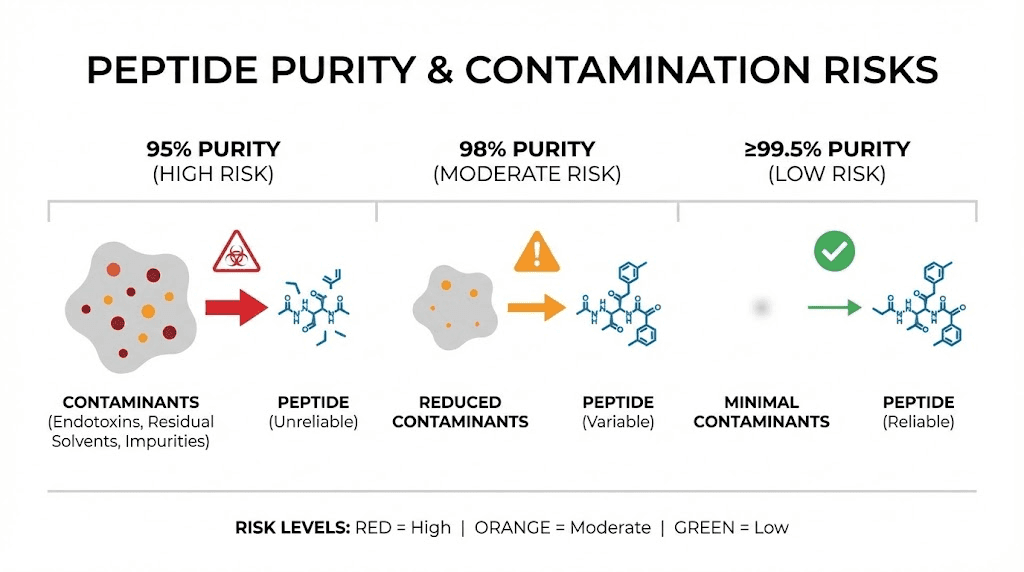
" Mass spectrometry responses "is the spotted substance constant with the designated peptide identification? " With each other they provide stronger batch-level evidence than either technique alone. In the usual peptide COA context, optimal pureness usually describes the portion of overall chromatogram location represented by the main peptide optimal.
Mass Spectrometry (ms): Identity Confirmation
They are classified "for research use just" to explain that they are intended for artificial insemination experiments or animal studies, not for any kind of type of human usage. In fact, a lab offering peptide testing must deliver information meeting the rigorous logical assumptions of companies like FDA and EMA [4] By utilizing a certified third-party laboratory, peptide suppliers or scientists guarantee an unbiased and skillfully documented evaluation of top quality, which is precisely what inspectors look for. In addition, continuous independent testing sustains compliance in set release and quality assurance. Laboratory recognition for peptides means making use of clinical tests to validate a peptide's identity, purity, and structure. In method, this commonly entails third-party or independent screening by an exterior laboratory to verify that a peptide product actually includes what the label claims [2]
Along with RP HPLC, our skilled researchers can additionally give info on the molecular weight of peptides identified by mass spectrometry. Matrix-assisted laser desorption ionization time-of-flight mass spectrometry (MALDI-TOF MS) and electrospray ionization mass spectrometry (ESI MS) are the two most generally made use of approaches. This post is offered instructional and study reference objectives only. All peptides sold by Pinnacle Lab are designated solely for in-vitro lab research study use and are not for human usage. Peptide screening documents must be interpreted as batch-level logical proof for study material, not as clinical-use authorization. Apex's Just how to Check out a Peptide COA guide walks through this process step by step.